
Plymouth City Council OKs 195-unit Apartment Project
The Plymouth City Council voted to let a mixed-use development proceed at the southwest corner of County Road 6 and County Road 101 that will include a four-story 195-unit apartment complex.
The vote happened at the Nov. 25 city council meeting that lasted three hours largely due to concerns about the project.
Plymouth residents who live near the site expressed reservations about the building’s size, traffic and parking issues.
The redevelopment is led by Prior Lake-based Marco McLane Development and Wayzata-based Mithun Cos. Their proposal would demolish much of the existing Plymouth Plaza retail building – a section that was a former grocery store – and relocate tenants to a new building on the site. The section of building where Original Pancake House is located would remain.
Despite opposition at meetings, the Plymouth City Council unanimously approved to reguide the property from commercial to mixed use and rezone the site from neighborhood commercial to a planned-unit development (PUD), which allows for greater flexibility in development.
“If you leave it commercial, this building is never going to change,” said Plymouth Mayor Jeff Wosje, who lives three blocks from the development. “No one is going to tear down that section that’s antiquated, that’s old.”
Wosje said he wanted to be consistent in his voting, noting that he also approved the Four Seasons redevelopment that included apartments. The project never came to fruition because of financial issues.
The mayor said he received more than 100 emails in a week about the project voicing concerns.
Apartments To Include Affordable Housing
According to the developers, the project would happen in phases. A new 14,200-square-foot building would be constructed on the northeast corner of the site where Northwest Family Clinics and Bay Creek Dental would relocate.
A 22,000-square-foot section of the 74,000-square foot Plymouth Plaza commercial building would remain where Original Pancake House, Dollar Tree and Great Clips are located. The leftover building would receive significant façade improvements.
Following demolition of the remaining Plymouth Plaza building, an “S-shaped” style apartment building would be constructed facing Olive Lane. Of the 195 proposed units, 20 percent or 39 units would be considered affordable housing.
Those affordable units would cater to tenants at 60 percent of area median income (AMI). Based on Metropolitan Council data, that would serve a family of four making about $79,000 a year.
“Allowing 39 units to come into this city is extremely important to me because it’s a start,” said Plymouth City Council Member Julie Pointner.
Tim Marco with Marco McLane Development said the project would cater to renters who are either young professionals or empty nesters. Monthly rent for a one-bedroom unit is expected to be around $1,750 and between $2,200-$2,400 for a two-bedroom apartment. Units considered affordable would be priced at $200 to $300 less than that, Marco said.
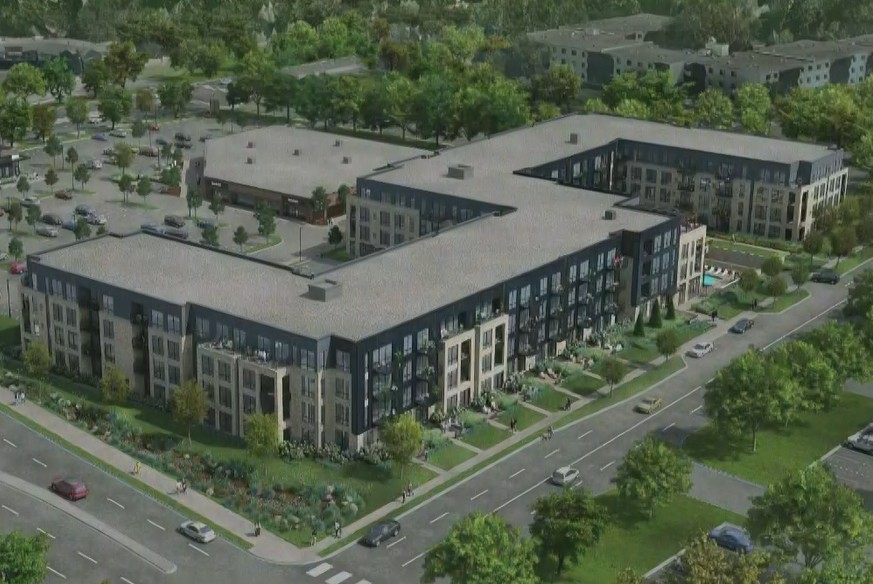
Rendering of proposed 195-unit apartment complex at Plymouth Plaza redevelopment site.
‘A Housing Shortage’
Support for the project centered around city leaders acknowledging a need for more housing.
“We have a housing shortage in this region and that housing shortage is significant, pricing seniors out of their homes as property values go up and they can’t find a place to live and stay in Plymouth,” said Plymouth City Council Member Joel Spoonheim.
Plymouth City Council Member Julie Peterson who represents Ward 2, where the project is located, said at the meeting that she “struggled” with her vote. Peterson said the vast majority of people she heard from were opposed, largely due to traffic concerns.
Peterson ultimately decided in favor because if the property remained commercial, traffic generated from new development could potentially be much worse.
“If the answer was no to this proposal, it’s a bit of rolling the dice, because you don’t know what’s going to show up in its place. You don’t how impact it would be to the character of the neighborhood,” said Peterson.
According to city officials, the project would require tax-increment financing (TIF) assistance for the affordable housing component to occur. TIF freezes the value of property over a period of time. New taxes generated by an increase in value would go back into the project for that duration. In this case, TIF would help fund about 8 percent of the $62 million housing project, officials said.
Construction of the overall project could take two-and-a-half to three years to complete.