
Local Mayors Demand State Aid, Accountability Following Operation Metro Surge
A nonpartisan coalition representing 21 Minnesota cities gathered at the state Capitol on Thursday to demand emergency municipal aid and legislative guardrails following the conclusion of Operation Metro Surge, the large-scale federal immigration enforcement that focused on the Twin Cities and across the state.
The Cities for Safe and Stable Communities Coalition represents more than 500,000 Minnesotans. They described a period of “federal overreach” that has left local economies reeling, exhausted city budgets, and fractured the trust between residents and law enforcement.
The mayors of Brooklyn Center, Golden Valley and Brooklyn Park were among those who provided accounts of ICE’s impact on their respective communities.
Brooklyn Center Mayor April Graves expressed deep concern over reports of racial profiling and the presence of masked agents. She noted that the lack of communication from federal agencies left local police in the dark.
“When I ask for information on what is happening from my police department, I can’t get any answers because they have no information that’s been shared with them,” Graves said.
She went on to say that some businesses in Brooklyn Center have had to close, while others have resorted to keeping doors locked during operating hours, with employees requiring escorts to reach their vehicles safely.
“Federal overreach has deepened already existing trust deficits in our community,” Graves added. “We must earn back that trust by focusing on solutions that serve our people, protect their constitutional rights and restore confidence in local leadership.”
Golden Valley Mayor Roslyn Harmon echoed those concerns. She said that the federal actions undermined years of work spent building relationships between communities of color and local police.
“When residents are afraid to contact law enforcement because they cannot tell the difference between a local officer and a federal agent, our entire safety net begins to collapse,” Harmon said.
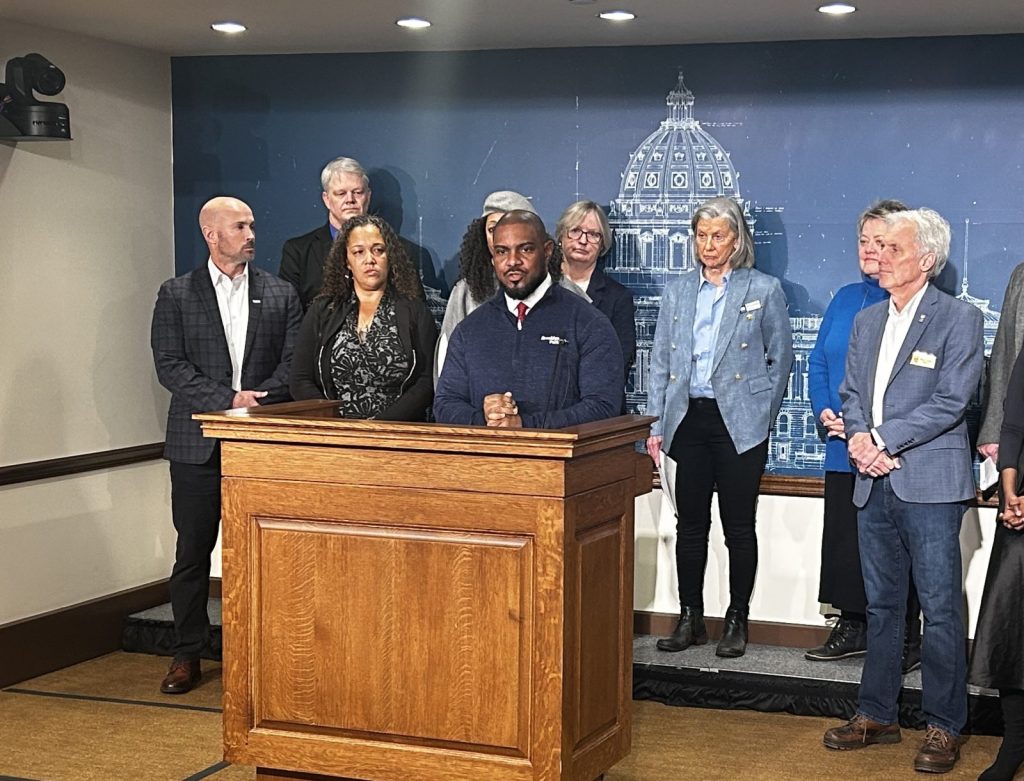
Brooklyn Park Mayor Hollies Winston, a member of the Cities for Safe and Stable Communities Coalition, addressed reporters at a news conference on Thursday, Feb. 19.
Brooklyn Park: Economic Instability and Budget Strains
Brooklyn Park Mayor Hollies Winston provided the most concrete look at the fiscal toll on Minnesota suburbs, describing the current spending levels as “unsustainable.”
He said Brooklyn Park has accrued nearly 215 hours of police overtime specifically linked to surge-related activities.
Local businesses, meanwhile, reported losses between 50 to 75 percent in sales and revenue, Winston said.
“Some simply are not able to offer services that we need within the city of Brooklyn Park, and additionally, some are simply flirting with closing their doors and going out of business,” Winston said.
Winston said Brooklyn Park has already tapped into its reserves to allocate more than $500,000 to assist struggling families and businesses. However, he called on the state government to act as a partner in recouping these costs.
“As our strongest partner, we need the state of Minnesota to acknowledge the economic harm done to our workforce and our families, and we need them to act now, and we need them to act with urgency,” Winston said.
The Coalition’s Legislative Priorities
The Cities for Safe and Stable Communities Coalition is not just asking for a check. Local leaders said they’re pushing for specific policy changes to prevent a recurrence of the last 10 weeks.
Their primary goals include:
- Municipal Aid: Direct funding to recoup police overtime, administrative costs and economic losses.
- Sensitive Locations: Reinstatement of “sensitive location” status for schools, hospitals, and places of worship.
- Identification: Prohibiting the use of masks by federal agents during local operations.
- Courthouse protections: Ending arrests for civil offenses at local courthouses.
“We won’t be asking for handouts; we are asking for fairness, for justice, and resources to fix a crisis we didn’t create,” said Hopkins Mayor Patrick Hanlon.
When asked how much aid the cities are looking for, Hanlon said they’re still trying to piece that together.
“We know it’s immense, we don’t know the exact number,” he said.
Related: ‘Beyond Frustrating’ and ‘Absolutely Despicable’: Brooklyn Park Police Chief Decries ICE Tactics

 CCX MEDIA
 NEWS
NEWS
 NEWS
NEWS
 SHOP/ORDER