
Robbinsdale District Committee Recommends Closures, One High School Only
Citing declining enrollment, a committee envisioning the future of Robbinsdale Area Schools sees school closures on the horizon.
The Reimagine Rdale: Vision 2030 team is recommending that the district’s two high schools, Cooper and Armstrong, be condensed into a single district high school.
Likewise, it recommends the district close and combine some of its elementary and middle schools.
The 37-member committee — comprised of students, district staff, parents, alumni and community members — presented its report to the school board on Tuesday, Sept. 23.
“We believe it’s critical to first acknowledge that the changes ahead will not be easy,” the Reimagine Rdale: Vision 2030 report read. “In fact, we expect them to result in a range of strong emotions (both positive and apprehensive) from students, parents/caregivers, staff, and the larger community. But the cost of inaction is far greater.”
The recommendations come after the district grappled with a $21 million deficit and laid off about 200 employees.
New High School Model
The committee recommends a new, modern high school replace the existing Armstrong and Cooper buildings.
“Ideally, this high school would be a new build in an entirely new location instead of renovating an existing campus,” the report read. “However, we recognize that a new building and/or a new location may not be feasible, so we recommend that the board rely on financial estimates, land availability and costs, as well as feedback from the community through a scientific survey conducted by an independent professional research firm to determine the best and most financially sound path forward.”
According to the committee, the district’s 18 aging school buildings are generally out of date and are expensive to maintain. There’s about $216 million in deferred maintenance costs between the school facilities, and about $73 million is characterized as “urgent.”
Meanwhile, school closings could potentially save district millions of dollars each year. Eliminating one of the district’s high schools is projected to bring $1.5 million in annual savings, while a middle school closure would save the district $1 million every year.
“We are aware that such bold changes would lead some to feel anger, fear, and grief,” the report read. “Pushback is inevitable. It will also take time and deeper analysis to finalize the details many community members wish to know now, including exactly how many schools need to be closed, which ones, and when. However, we also believe there is a genuine opportunity for the community to feel hopeful, inspired, and excited about the district’s new direction.”
The report also recommends updating schools with flexible learning spaces, outdoor classrooms, dedicated arts spaces and secure single-stall bathrooms.
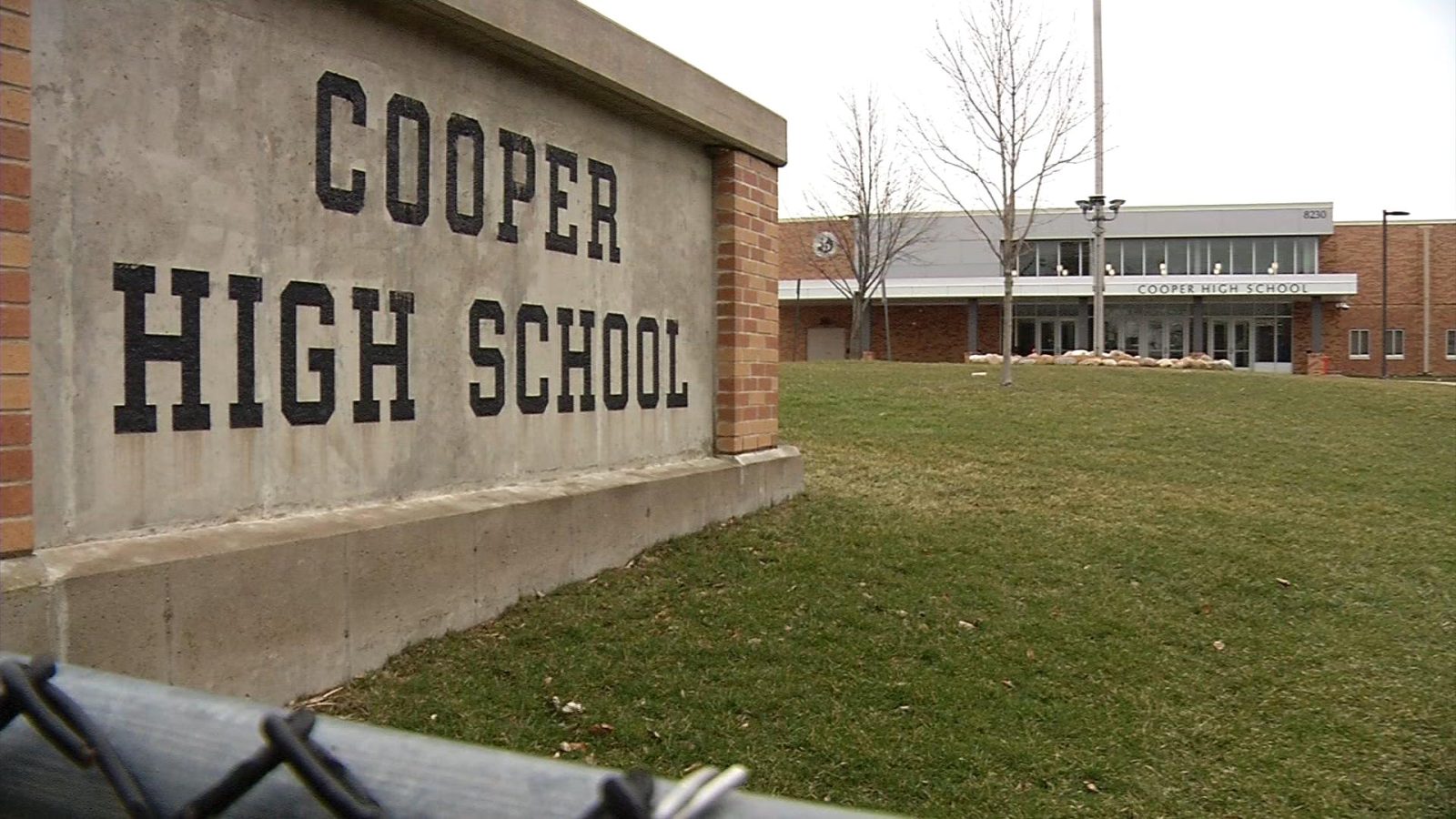
The exterior of Cooper High School. The Reimagine Rdale: Vision 2030 team is recommending that the district’s two high schools, Cooper and Armstrong, be condensed into a single district high school.
Declining Enrollment
According to the report, Robbinsdale Area Schools had 28,000 students in 1971. That decreased to 10,253 for the 2024-2025 school year, and continued declines are expected.
The report was drafted with the assumption that enrollment will decline to 9,500 by 2030.
Bonding
The committee stressed that a voter-approved bond referendum would likely be needed for future building plans.
According to the district, it’s been about 45 years since voters in the Robbinsdale Area Schools have approved a building bond referendum.
“While consolidating schools would significantly reduce ongoing operating expenses, the transformations the Vision Team is recommending would also require upfront investment,” the report read. “To create modernized, future-ready schools with enhanced security, the district would need the community’s support through a bond initiative. The bond would ensure that every student, regardless of which Robbinsdale school they attend, learns in a safe, high-quality environment designed for the future.”
Timeline
The Minnesota Department of Education placed the district in a status known as statutory operating debt due to its $21 million budget deficit.
As a result, it must submit a plan to the state by January 31, 2026, explaining how the district will fix its finances.
The school board is expected to review the report and see how its recommendations fit into the the statutory operating debt plan.
District officials provided the following tentative timeline for the short-term decision making process:
- September 2025: Board provides direction to administration to develop options for both the statutory operating debt plan and the Reimagine Rdale recommendations.
- October 2025: Administration shares additional information and recommendations for board consideration.
- November 2025: Administration and school board refine information to reach final facility repurposing and related items for the 2026-27 school year; long-term facilities and programming discussions begin; statutory operating debt components refined.
- December 2025: Public meetings are held; final 2026-27 facility repurposing and related items approved.
- January 2026: Final statutory operating debt plan approved and submitted to the Minnesota Department of Education by Jan, 31, 2026.
The following phased plan offers a long-term look at potential changes in the district through 2030.
- Phase I (Sept. 2025 – Aug. 2026): Develop and approve the statutory operating debt plan; reduce district footprint through initial building closures, consolidations, or reconfigurations; plan remaining building configuration and related bond work; create initial boundary adjustments; finalize initial operational changes.
- Phase II (Jan. 2026 – Aug. 2027): Implement initial reconfigurations; finalize longer-term building configuration and bonding needs (Nov. 2026); plan long-term programmatic, operational, and boundary changes; potentially begin first facility improvements.
- Phase III (March 2027 – Aug. 2028): Implement additional reconfiguration moves without facility improvements; begin facility improvement projects; continue programmatic planning and preparation; stage facility transitions.
- Phase IV (March 2028 – Aug. 2029): Carry out facility improvements; implement programmatic changes; prepare for additional programming; complete facility moves.
- Phase V (March 2029 – Aug. 2030): Fully implement Reimagine Rdale 2030; complete the statutory operating debt plan.
 Armstrong High School
 Cooper High School
Crystal | Golden Valley | New Hope | Plymouth | Robbinsdale