
Hunger Relief Orgs Call for an End to ICE’s Operation Metro Surge
About two dozen volunteers formed an assembly line for a special project in the warehouse at Brooklyn Park’s Second Harvest Heartland on Wednesday, Jan. 28.
They passed cardboard boxes back and forth to fill with pasta, sauces, cereal and canned meat — enough to feed a family multiple meals.
At the end of the line, where the full boxes were stacked and shrink-wrapped, a volunteer would occasionally ring a bell and be met with cheers.
“That bell sound, that is the sound of a pallet being finished and moving out into the community,” said Sarah Moberg, CEO of Second Harvest Heartland.
Each finished pallet carries dozens of the latest offering from Second Harvest: emergency food boxes.
They’ll be distributed to local food shelves, schools and faith-based organizations, and eventually end up with hungry families.
These emergency food boxes are part of an initiative that Second Harvest started as Operation Metro Surge brought an influx of U.S. Immigration and Customs Enforcement (ICE) agents to Minnesota.
“There’s been widespread fear and anxiety and so people are choosing not to leave their home,” Moberg said. “And so the ways that they are accustomed to getting food, meaning school lunches, or grocery stores, food shelves — those don’t feel safe right now. And so these emergency boxes are a response to that.”
Food Relief Orgs Release Joint Statement
Second Harvest Heartland, the second largest food bank in the nation, is one of more than a hundred food relief agencies that signed onto a joint statement calling for the end of Operation Metro Surge.
“Minnesota is fortunate to have a strong and resilient hunger-relief network, especially in times of crisis such as this,” the statement reads. “However, with so many Minnesotans staying home for fear of being racially profiled, unlawfully detained, separated from their families or worse, we have had to scramble to find new ways to get emergency food to where it’s needed most. Minnesotans have shown up to keep one another fed. Yet at every turn, ICE has made it harder to get food to hungry neighbors, including by following volunteers doing food deliveries, standing outside food shelf entrances, staging from our parking lots or near our facilities, and, in at least one instance, detaining a volunteer. This is on top of the impact on child hunger from missed school meals.”
Other signees in the northwest metro include CAPI USA, Community Emergency Assistance Programs, NEAR Food Shelf and The Food Group.
“Let us be clear: every Minnesotan—indeed, every human being—deserves to eat,” the statement continues. “That should not be a controversial statement, and it certainly isn’t a political one. As nonpartisan, nonprofit organizations, we represent a wide variety of viewpoints, beliefs, and life experiences. What we all share is a deep commitment to ending hunger in our communities, and every day that this federal operation continues moves us further from that goal.”
Moberg said Second Harvest hasn’t been directly targeted by ICE.
“So far, we have not seen activity directly on our property,” Moberg said. “But we do know that Brooklyn Park has seen a fair amount of activity.”
Federal officials have given no indication that Operation Metro Surge will end amid recent leadership changes and high-profile shootings.
As a result, Second Harvest plans to continue providing emergency boxes the the community through the duration of the campaign.
“We’re committed and expecting to need over 50,000 boxes over the next handful of weeks,” Moberg said. “And we’ll continue to be here for as long as the community needs us.”
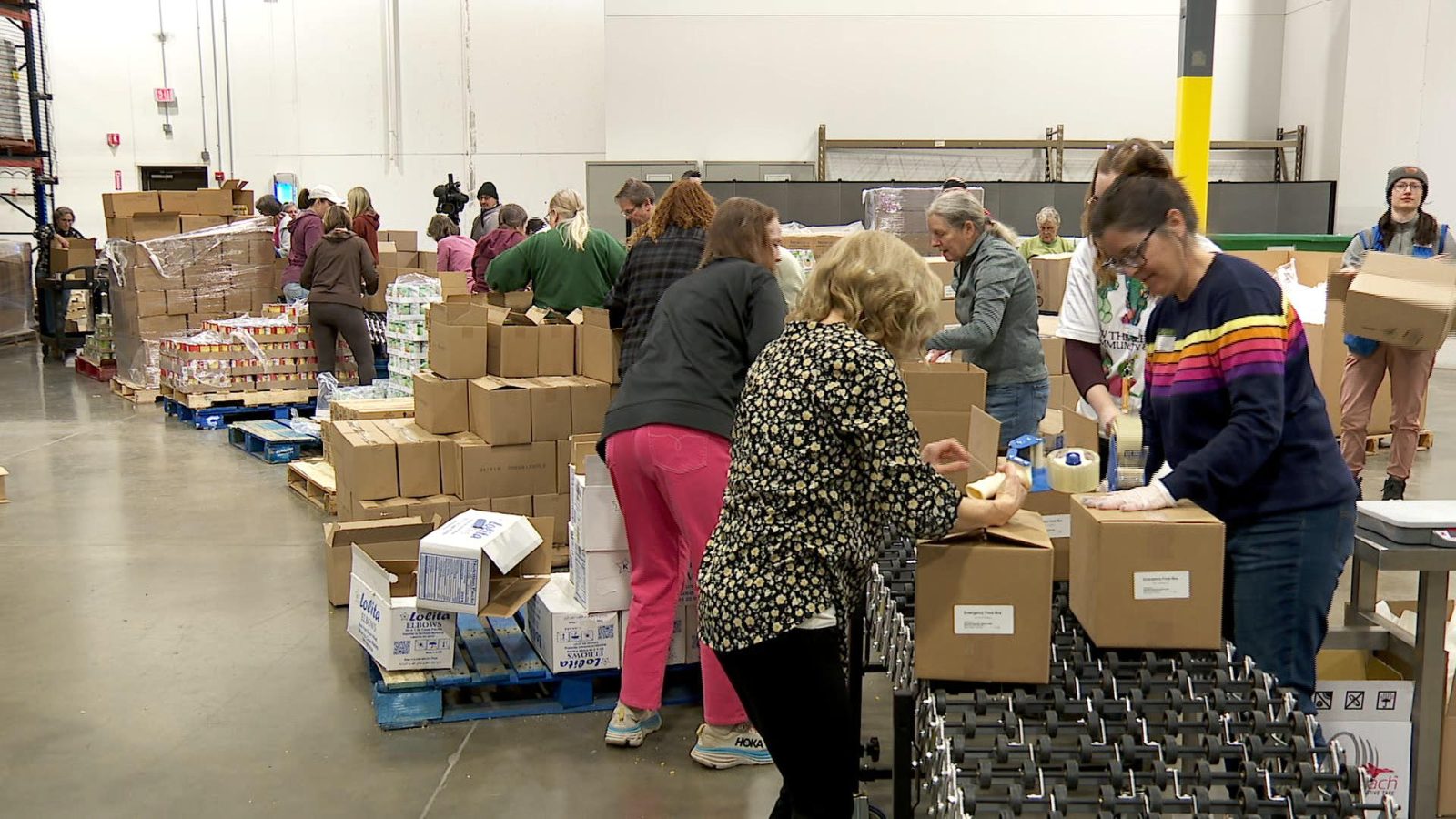
Volunteers pack boxes with food at Second Harvest Heartland in Brooklyn Park. Second Harvest is one of more than a hundred food relief agencies that signed onto a joint statement calling for the end of Operation Metro Surge.
Full Statement From Hunger Relief Organizations
The full statement from the hunger relief organizations is available below:
Since the start of Operation Metro Surge in early December, the presence of thousands of federal ICE agents has brought chaos and violence to the communities we serve, leaving a growing number of our neighbors— including U.S. citizens—too afraid to leave their homes.
People are stranded and hungry. This cannot continue.
Minnesota is fortunate to have a strong and resilient hunger-relief network, especially in times of crisis such as this. However, with so many
Minnesotans staying home for fear of being racially profiled, unlawfully detained, separated from their families or worse, we have had to scramble to find new ways to get emergency food to where it’s needed most. Minnesotans have shown up to keep one another fed. Yet at every turn, ICE has made it harder to get food to hungry neighbors, including by following volunteers doing food deliveries, standing outside food shelf entrances, staging from our parking lots or near our facilities, and, in at least one instance, detaining a volunteer. This is on top of the impact on child hunger from missed school meals.Let us be clear: every Minnesotan—indeed, every human being—deserves to eat. That should not be a controversial statement, and it certainly isn’t a political one. As nonpartisan, nonprofit organizations, we represent a wide variety of viewpoints, beliefs, and life experiences. What we all share is a deep commitment to ending hunger in our communities, and every day that this federal operation continues moves us further from that goal.
For the above reasons, and out of deep concern for our neighbors, we stand united in calling for an immediate end to the surge in federal
immigration activity in our state so that we can safely deliver food to neighbors in need and ensure that they can freely attend school and
access healthcare and other lifesaving services without fear. Operation Metro Surge is hurting our neighbors, it is making us less safe, it is
further dividing our communities, and it is making it harder to get food to Minnesotans in need. Our communities deserve better.”