
On Your Ballot: Voters To Decide Constitutional Amendment To Boost School Funding
A constitutional amendment is on the ballots of Minnesota voters this fall. It will bring more money to public schools statewide at no additional cost to taxpayers.
What Is The Permanent School Fund?
The state of Minnesota was built on a foundation of learning. In 1858, the state set aside public lands to support public schools. Under that language, up to 2.5 percent of funds received from the state’s natural resources would go to support public schools. The amount distributed to schools depends on the number of students enrolled. For districts like Osseo Area Schools, that’s $1.3 million annually.
“It just says a lot about our state that the people who founded our state set up a public fund expressly for public education,” said Paul Peltier, task force member of the Permanent School Fund.
Peltier lives in the Iron Range, where much of that public land is located. He said the fund continually earns revenue from the state’s natural resources. The 2.5 percent system currently gives schools about $68 per student. But the land was profitable — and there is room for schools to get more.
Peltier was part of the committee that proposed the 4.5 percent funding increase. Because it’s pulling from existing money, an increase won’t cost taxpayers anything. The plan had strong bipartisan legislative support. But increasing that percentage now is up to the voters.
“On November 3rd, every Minnesotan across the state will have a question that says ‘Shall the permanent school fund be adjusted to increase distributions at no cost to local taxpayers?'” Peltier said.
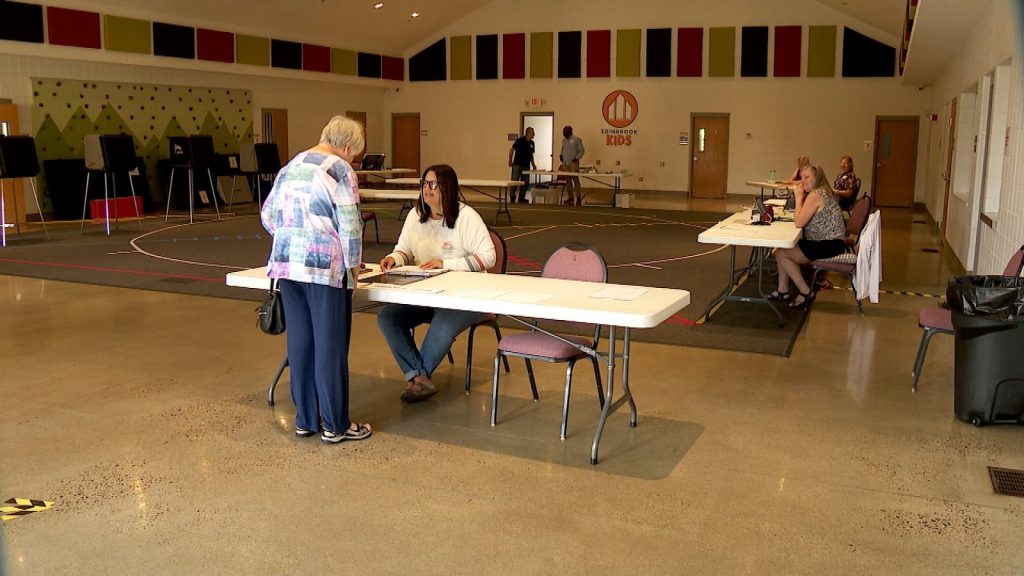
A voter checks in with an election judge at the Edinbrook Church polling place in 2025.
A Local Impact
Osseo Area Schools said the amendment could add $680,000 annually to its budget totaling about $101 per student. The money would go into a general fund for each district. John Morstad, the district’s executive director of finance and operations, said the money would be impactful.
“With the proposal, that would add another five, six teachers that we could fund, tax free,” Morstad said. “Funding schools is difficult. Always is, so any additional dollars that can be received are an enormous benefit to a district. And this opportunity is incredibly unique, in that this will not have a tax impact.”
Typically, for schools to get more funding, they have to put out a request to voters.
The Robbinsdale Area School District currently has a bonding request on the ballot. In the past, Osseo Area Schools had luck with building referendums, such as with the Building a Better Future plan, which provided funding for construction projects across the district.
“Every little bit helps to keep the train on the rails and running the way its supposed to,” Morstad said.
For constitutional amendments, a choice not to vote on the item counts as a “no” vote. Leaders say when you see it on your ballot, it’s important to make a choice either way.

The new media center is located right after the front doors at Osseo Senior High. This project was made possible thanks to voter referendums, a different funding source than the fund.
Amendment Question
According to the Secretary of State’s office, the question will look like this on voters’ ballots:
Failure to vote on a constitutional amendment will have the same effect as voting no on the amendment.
To vote for a proposed constitutional amendment, fill in the oval next to the word “Yes” on that question. To vote against a proposed constitutional amendment, fill in the oval next to the word “No” on that question.
Increasing funding to school districts
Shall the Minnesota Constitution be amended to increase the funding going to all school districts from the permanent school fund, which is a fund that supports school districts without raising individual income or property taxes, effective July 1, 2027?
Yes
No
Brooklyn Center | Brooklyn Park | Crystal | Golden Valley | Maple Grove | New Hope | Osseo | Plymouth | Robbinsdale | Twin Cities

 CCX MEDIA
 NEWS
 NEWS
 SHOP/ORDER